10 - Learning Control in a Brand New Day
Learning Control in a Brand New Day
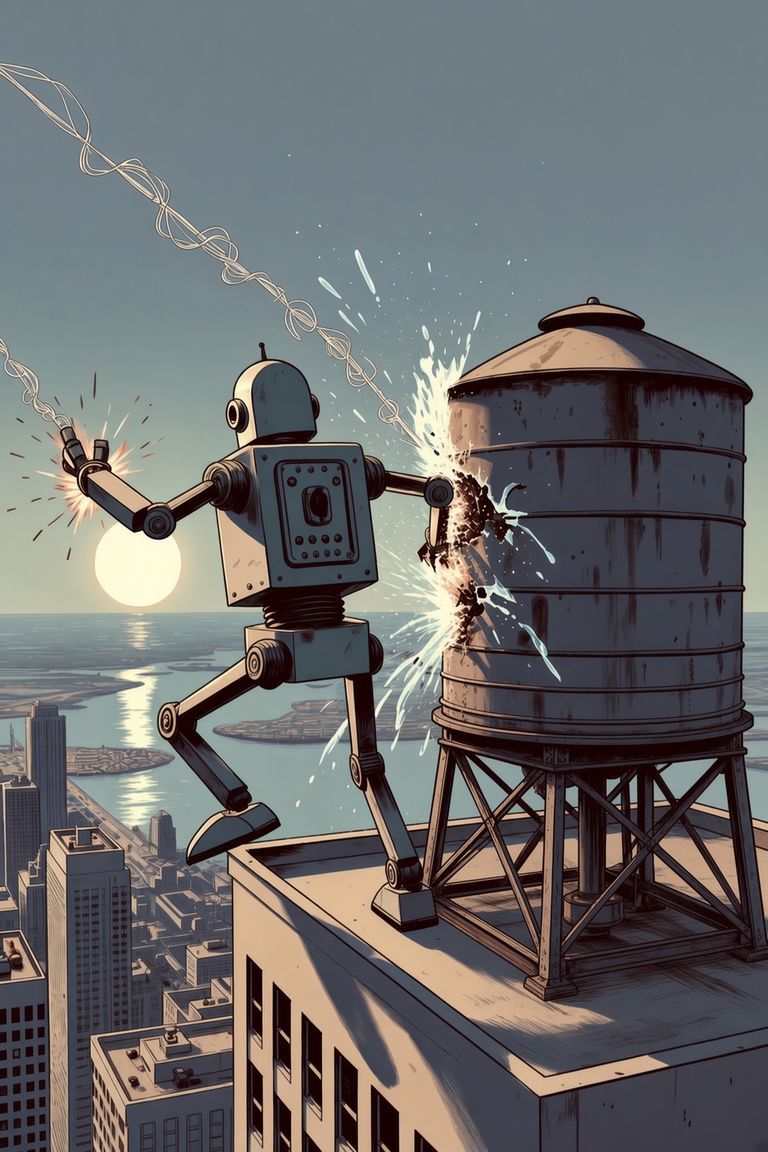
In Spider-Man: Brand New Day, Peter isn’t a newbie learning to be a hero, yet in the trailer we see a flailing Spider-Man plowing through a rooftop water tank. The implied question is whether Spider-Man will find the control to master his altered powers.
We have a similar challenge with AI.
The AI agent is an external prosthetic: more reach and more force, with no taste of its own. We still manage the process and are responsible for what ships. Generation got ~100× faster; our ability to steer didn't. Models are still weak at review, and LLM-assisted review often shares the same input and blind spots as the generator, including ignorance of the audience.
Everyone knows the frustration of reading AI output the “author” never actually read — or of generating a wall of text or code, sending it out in a rush, and sheepishly having to admit that you weren't taking care with what you sent.
Raw output is a joke without a punchline, text without an author.
Suddenly, the scarce resource is a person guiding and editing — expert judgment that can still hold policy, house rules, and reader needs against model tendencies. The craft moved from making to shaping.
What flipped
When humans (and early AI) produced the work, quantity was costly. Volume and length usually meant effort and often competence. When coding software, creating changes that compiled and worked was taxing enough that quantity limited itself.
Agents removed that governor. Now large code change diffs and long answers are automatic. Volume stops reading as passion and starts reading as indifference.
Like a beginning musician, a generator running free will play every note it can. Inexperience is:
- No selection: opera or jingle, scale and scope chosen by model assumption rather than the occasion
- No balance: the point and the padding arrive at the same volume; nothing stands back, so nothing soars
- No opening night: no difference between rehearsal and performance, "done" just means the agent stopped typing
In code there's a second-order cost. Unlabeled anti-patterns become templates. Agents mimic examples by design, so silent ugliness with no danger signs gets duplicated. Humans slow-copied bad patterns, and review usually caught them. Agents fast-copy them across whatever surface you open. The antidote is cheap and specific: agent-legible keep-out signs in the source. Do not use as a template; do X instead.
Sometimes the occasion really does call for the opera. What's missing isn't smallness, it's the choosing. And on a coding agent, a chat message, or a doc, the arithmetic is the same: it's written once and read many times, so a minute you spend refining is a minute saved for every reader after you.
None of this is free. Editing costs throughput: fewer diffs, slower replies, shorter answers. The delay is visible while the judgment that produced it isn't. So we let the agent run.
Fit and finish is the skill that communicates care — not more sound or more notes, but where it goes, how much, and especially what is left out, so what matters shines through for the person on the other end.
- ← Previous
9 - LLM Adoption Burnout and the Hidden Tax